WHAT WE DO
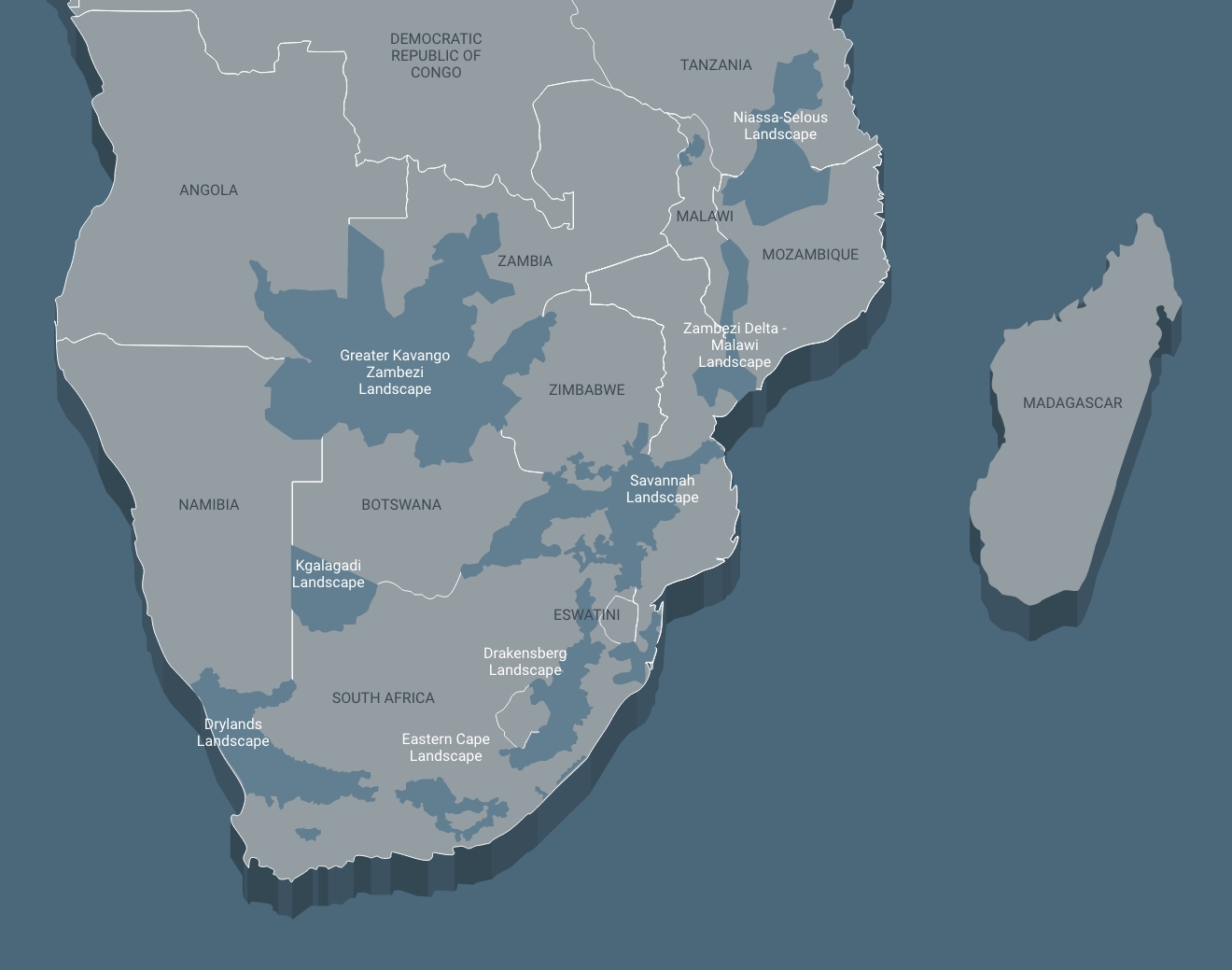
Our conservation is built around three interconnected priorities: species, landscapes and people. We protect threatened animal and plant species, secure and restore the places they need to survive, and work with the people who live, work and make decisions within these landscapes.
WHAT WE DO
OUR EIGHT STRATEGIC
CONSERVATION
LANDSCAPES
Greater Kavango
Zambezi Strategic
Conservation Landscape
Species we protect
Carnivores
Birds of Prey
Cranes
Threatened
Endemics
Zambezi to Malawi
Strategic Conservation
Landscape
Species we protect
Carnivores
Birds of Prey
Cranes
Threatened
Endemics
Savannah
Strategic Conservation
Landscape
Species we protect
Carnivores
Birds of Prey
Threatened
Endemics
Niassa-Selous
Strategic Conservation
Landscape
Species we protect
Carnivores
Birds of Prey
Threatened
Endemics
Eastern Cape
Strategic Conservation
Landscape
Species we protect
Carnivores
Birds of Prey
Cranes
Threatened
Endemics
Kgalagadi
Strategic Conservation
Landscape
Species we protect
Carnivores
Birds of Prey
Threatened
Endemics
Drylands
Strategic Conservation
Landscape
Species we protect
Birds of Prey
Threatened
Endemics
Drakensberg
Strategic Conservation
Landscape
Species we protect
Birds of Prey
Cranes
Threatened
Endemics
Across our eight Strategic Conservation Landscapes in Africa, our teams combine science, field expertise, local knowledge and partnerships to understand conservation challenges and put practical solutions into action.
WHAT WE DO
OUR CONSERVATION
FOCUS
Protecting threatened
species
Threatened species have been at the heart of the EWT since its inception in 1973.
We apply our on-the-ground expertise to protect birds of prey, carnivores, cranes and threatened endemic species as part of a landscape-based approach that safeguards a much wider diversity of animal and plant life.
We research and monitor species, address the threats driving their decline, protect and reconnect habitat, support population recovery and, where appropriate, return species to places from which they have disappeared.
When a species faces an urgent conservation crisis, we can also bring our expertise and capacity into a wider response, working with partners to achieve the greatest possible impact.
Securing and restoring
landscapes
Healthy, connected landscapes provide the habitat wildlife needs to survive and the natural systems that support people.
We secure, connect and restore ecosystems, from grasslands and wetlands to forests, rivers and other important habitats.
Our interventions include restoring degraded areas, reconnecting fragmented habitats, expanding protected and conserved areas, and strengthening long-term land management with landowners and communities.
Through our eight Strategic Conservation Landscapes, we bring these activities together to protect and restore natural systems across larger, connected areas.
Working with people
People are an integral part of the landscapes in which we work.
We recognise the knowledge and experience that communities, landowners, farmers and other local stakeholders bring to conservation.
By listening, learning and working together, we develop solutions suited to local conditions that protect wildlife while recognising people’s needs, livelihoods and priorities.
WHAT WE DO
OUR STRATEGIC
CONSERVATION
APPROACHES
Specialist expertise. Greater conservation impact.
Alongside our on-the-ground work, we have specialist teams that address conservation challenges requiring particular knowledge, skills and resources.
These challenges range from illegal wildlife trade to threats posed by infrastructure development and require a diverse array of strategic interventions including but not limited to land protection, community engagement, applied research, habitat restoration, wildlife management and conservation finance.
Our Strategic Conservation Approaches bring this expertise into our landscape-based conservation, strengthening the work of our field teams and helping us address challenges that extend beyond individual species or habitats.
These specialist capabilities can also be applied beyond our Strategic Conservation Landscapes, wherever our expertise can achieve meaningful conservation impact.
WHAT WE DO
CONSERVATION
THROUGH
COLLABORATION
Our eight Strategic Conservation Landscapes anchor our long-term, place-based conservation, but our reach is not limited to their boundaries.
We also work beyond these landscapes where there is a strategic conservation need, or where a threatened species faces an urgent crisis that requires our specialist expertise. These interventions are carefully considered, drawing on our teams’ knowledge, capacity and partnerships to determine where we can make the greatest conservation impact.
All of our conservation takes place in Africa, with funding and partnerships extending around the world. Through the Endangered Wildlife Trust USA, American individuals, foundations and corporations can contribute directly to protecting Africa’s threatened wildlife, securing important habitats and supporting the people who share these landscapes.

NIASSA-SELOUS
FOR WILDLIFE. FOR
PEOPLE. FOR AFRICA
Whether we are recovering a threatened species, restoring habitat, securing land for conservation, combating wildlife crime, making infrastructure safer or working with communities, our purpose remains the same: delivering practical conservation with lasting impact.